
Blue Strip on Antibiotics: A Step Toward Stronger Antimicrobial Stewardship in India?
Regulatory & Policy Updates | India Pharma Landscape
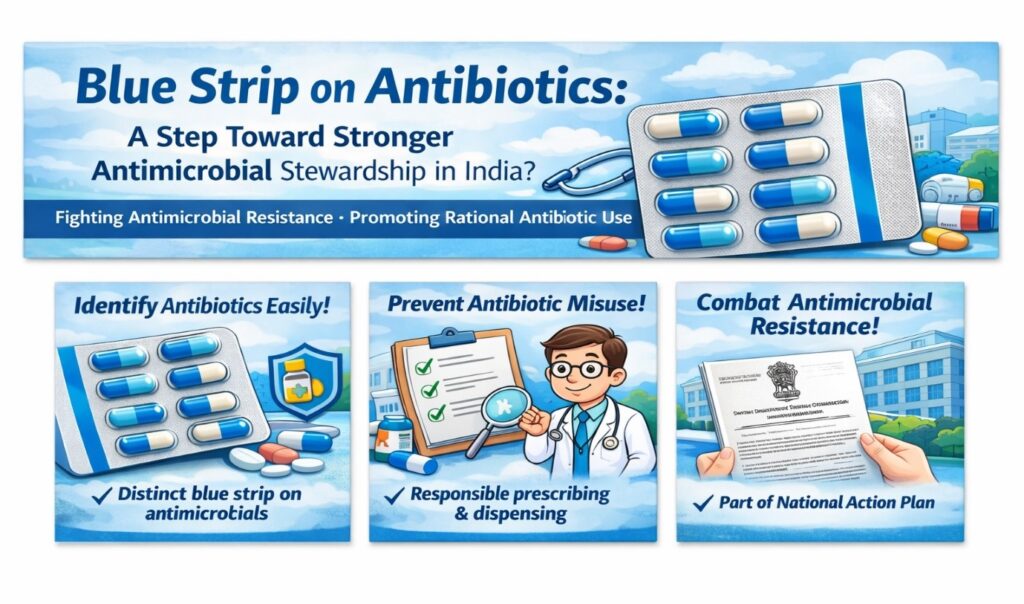
India is taking another significant step in its fight against antimicrobial resistance (AMR). A recent draft notification issued by the Ministry of Health and Family Welfare proposes that all antimicrobial drugs and their formulations should carry a distinct blue vertical strip on the label.
The move is currently in the draft stage and open for public consultation. While it has sparked discussion within industry circles, the proposal reflects India’s continuing efforts to strengthen antibiotic stewardship and improve public awareness.
Why the Blue Strip?
Antimicrobial resistance is one of the most pressing public health challenges globally. Misuse and overuse of antibiotics — whether through self-medication, incomplete courses, or inappropriate prescriptions — accelerate the development of resistant strains of bacteria.
India has already introduced several regulatory measures over the years, including:
- Schedule H and H1 prescription restrictions
- Red line labeling for certain medicines
- Pharmacovigilance and surveillance initiatives
- Public awareness campaigns
The proposed blue strip aims to make antimicrobial medicines easily identifiable at a glance. The objective is simple: improve visibility, reinforce caution, and encourage responsible use.
If implemented, the strip would appear as a conspicuous blue vertical line running along the left side of the label across antimicrobial products.
Regulatory Context
The proposal comes as part of amendments to the Drugs Rules, 1945 under the Drugs and Cosmetics Act, 1940. It aligns with India’s broader National Action Plan on Antimicrobial Resistance (NAP-AMR), which focuses on:
- Strengthening surveillance systems
- Promoting rational antibiotic use
- Enhancing regulatory enforcement
- Increasing public awareness
The draft has been published in the Official Gazette, allowing stakeholders — including manufacturers, healthcare professionals, and industry associations — to provide feedback before finalisation.
Industry Perspective
As with any regulatory change, operational considerations are part of the conversation. Industry stakeholders have highlighted aspects such as:
- Packaging modification timelines
- Cost implications for manufacturers
- Supply chain adjustments
- Need for harmonisation with existing labeling systems
These discussions are part of the standard consultative process that accompanies draft regulations. Constructive dialogue between regulators and industry often ensures that public health objectives and operational feasibility are balanced effectively.
Potential Public Health Impact
Visual cues on medicine packaging have been used globally to improve awareness and compliance. While labeling alone cannot solve antimicrobial resistance, it can serve as an additional behavioral prompt.
A blue strip could:
- Help pharmacists quickly identify antimicrobial drugs
- Alert patients that the medicine requires responsible use
- Reinforce prescription-based dispensing
- Support antimicrobial stewardship programs
However, experts widely agree that labeling must work in combination with:
- Strong prescription enforcement
- Public education campaigns
- Clinical stewardship programs
- Surveillance of resistance patterns
AMR is a multi-dimensional issue that requires coordinated action across healthcare, regulatory systems, and community behavior.
A Broader Message on Stewardship
The proposed measure highlights a broader shift in pharmaceutical regulation — from purely compliance-based frameworks to behavior-influencing public health strategies.
Antibiotic effectiveness is a shared national resource. Protecting it requires collaboration between:
- Policymakers
- Pharmaceutical manufacturers
- Healthcare professionals
- Pharmacists
- Patients
The blue strip proposal underscores that antimicrobial resistance is not just a clinical issue but also a societal responsibility.
What Happens Next?
Since the notification is currently in draft form, stakeholder feedback will play a key role in shaping the final outcome. After reviewing objections and suggestions, the government may issue a final rule with defined implementation timelines.
Until then, the discussion continues — reflecting the evolving nature of pharmaceutical regulation in India.
Pharma Parivesh Insight
Whether through labeling innovations, awareness initiatives, or regulatory strengthening, the direction remains clear: responsible antibiotic use is essential for safeguarding future healthcare outcomes. The blue strip proposal is one more step in India’s ongoing journey toward stronger antimicrobial stewardship.